Puppy Journey · 4–6 months
Your 4 to 6-Month-Old Puppy
Two things arrive together: more of the world, once your veterinarian says the series is finished, and the permanent teeth. Across these three months one of them gets easier and the other does not.
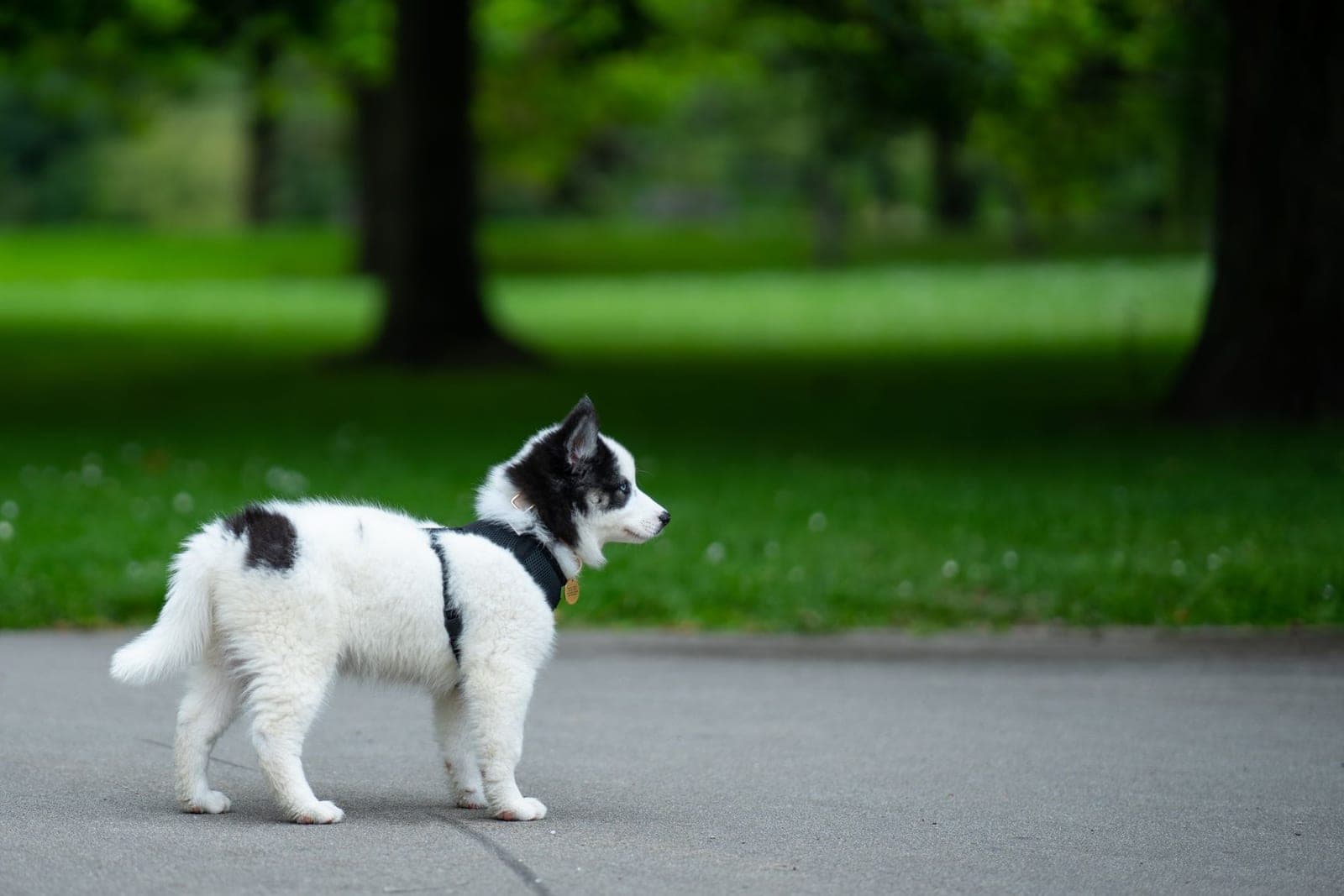
Where you are now
The world opens and the teeth arrive — then, slowly, settle.
Where you are now
The world opens and the teeth arrive — then, slowly, settle.
Two things change at the start of this period and they pull in opposite directions. For most puppies the primary vaccination series is finished or finishing, which — once your veterinarian confirms it — opens up where you can reasonably go. And the permanent teeth start coming through, which makes a puppy that was already chewing considerably worse to live with.
This stage covers three months rather than one because that is how long those two things take to play out. Around four months the chewing is at its most destructive and the world is newly available. By six it is a different animal: the mouth is nearly finished, the outings are routine, and two conversations have usually come back round — whether this dog is being neutered and when, and whether your clinic wants a further vaccine dose now rather than at a year old.
None of it is adolescence. That is still ahead, and the work you put in here is what it draws on.
- Ask your veterinarian to confirm the series is complete rather than assuming it from a date.
- Chewing gets worse before it gets better. Manage it; do not try to train it away.
- Practise in harder places, not harder exercises.
- House-training is usually good and not usually finished.
- The neutering conversation starts here and, for a smaller dog, usually concludes here. The answer depends on size.
- Towards six months there is often a second vaccination conversation. It is a decision, not a formality.
Development
More confident, more opinionated, and still learning by context.
Development
More confident, more opinionated, and still learning by context.
A puppy of this age is physically much more capable and noticeably more independent. It will go further from you, investigate more on its own account, and show clearer preferences about what it does and does not want to do. Curiosity outruns judgement by a wide margin, which is why the recall work in this period matters more than it feels like it does.
Learning is still strongly tied to context. A behaviour that is solid in the garden may be absent on a pavement with a bin lorry going past, and that is a gap in practice rather than a refusal. Reading it as defiance is the most common mistake of this age and it leads to pressure being applied where repetition was needed.
This is not adolescence. The research that describes a dip in trainability during adolescence places it at around eight months and treats five months as the phase before it, so a puppy here is on the near side of that. What you are seeing is a confident young dog with incomplete generalisation, not a teenager.
Permanent teeth and chewing
The physical fact that defines this phase, and the one that ends during it.
Permanent teeth and chewing
The physical fact that defines this phase, and the one that ends during it.
This is the period the chewing has been building towards. The Merck Veterinary Manual puts the appearance of the permanent teeth at around four to five months, with all of them present by about seven — so what you are dealing with now has a physical cause, a known trajectory, and an end.
That changes the job from correction to management, and it changes puppy-proofing. A four-month-old can reach higher, is more determined, and has a mouth that wants pressure on it. Go round the house again at the new height: chair legs, table edges, remote controls, shoes left by the door, cables that were previously out of reach and are not any more.
Give the mouth somewhere legal to go. Keep a rotation so items stay interesting, and use cold — a wet flannel frozen into a twist, or a stuffed toy from the freezer — which does more for a sore mouth than anything you can say. On what to give, the useful conversation is with your veterinarian rather than a shelf: hardness is the thing to ask about, because chews that do not give at all are a recognised cause of fractured teeth, and “natural” is not a synonym for safe.
Chewing is normal; swallowing is the risk, and it does not go away because the puppy is older. Anything given should be too large to swallow and should be taken away as it wears down. Losing a baby tooth, a spot of blood on a toy, or finding nothing at all are all ordinary. What is worth a veterinary look is a mouth that seems painful rather than itchy, or a tooth that is broken rather than shed.
The other end of this is worth knowing about, because it arrives inside this stage. Merck puts the full set of permanent teeth in place by about seven months, so by six the process is progressing towards completion rather than finished — the chewing usually eases before the last teeth are through. If a baby tooth is still firmly in place alongside the adult tooth replacing it by around this point, that is worth raising rather than waiting on. It is a common thing for a veterinarian to look at, and if a dog is going to be anaesthetised for neutering anyway, the two are sometimes dealt with in the same event. That is a conversation to have rather than an expectation to arrive with.
Socialisation and outings
More access, once it is confirmed — and access is not the same as exposure.
Socialisation and outings
More access, once it is confirmed — and access is not the same as exposure.
Do not assume the series is complete because a certain number of weeks have passed. Ask, get an answer, and ask what it changes: whether the whole world is now reasonable, or whether there are still places your veterinarian would avoid given the disease picture where you live.
Once you have that, widen deliberately rather than all at once. Neighbourhood pavements, a quiet high street, a café terrace, a car park, a bus stop, gravel and metal grates and wet grass — the value is in the variety of surfaces and situations, not in the number of dogs met. Increase complexity a rung at a time and keep the sessions short enough that the puppy is still enjoying itself when you leave.
The thing to resist is the shortcut. A dog park is not socialisation; it is a crowd of strangers with no supervision, and for a four-month-old with no reliable recall it is a way to acquire a problem rather than prevent one. Structured interaction — a known adult dog with good manners, a well-run class — teaches far more than volume does. One calm experience the puppy could have walked away from is worth an afternoon of being carried through a crowd.
Training
Same behaviours, harder rooms. Nothing here is reliable yet.
Training
Same behaviours, harder rooms. Nothing here is reliable yet.
The list does not get longer at this age; the conditions get harder. Everything below is work you have already started, moved somewhere it has not worked before, and none of it is finished — a puppy that performs beautifully on the drive is not a dog you can trust off-lead at the park.
- Recall against real distraction, on a long line, so that you never call a recall you cannot back up. Pay it enormously, every time, and never call to end something the puppy is enjoying.
- Lead work on actual pavements. Two good minutes at the end of the road beats twenty minutes of pulling, and rewarding the position you want beats correcting the one you do not.
- Settling away from home — outside a shop, at a café table, in the car. It is the most transferable thing you can teach and the least practised.
- Impulse-control foundations, in their simplest form: waiting a beat before the door opens, before the bowl goes down, before the lead comes off. Short, boring, and enormously useful later.
- Handling that stays cooperative: a paw offered rather than taken, ended before the puppy wants it to end. The mouth needs looking at more often now, so it is worth being easy.
- One set of rules across the household. A puppy can learn any rule and cannot learn four versions of it, and this is the age where inconsistency starts to show.
House-training
Usually good. Usually not finished.
House-training
Usually good. Usually not finished.
Most puppies are reliable for long stretches by now, which is exactly when the routine gets relaxed and the accidents come back. Extend the intervals gradually rather than withdrawing the schedule, and keep some supervision indoors — an unwatched puppy with a full bladder in a room you are not in is not a training failure waiting to happen, it is one already underway.
Expect setbacks around change: a new schedule, a house move, a stretch of bad weather, a day left longer than usual. Accidents are information about what changed rather than misbehaviour, and punishing them teaches a dog to go where you cannot see it — which is a harder problem than the one you started with.
One thing is worth separating from training entirely. A dog that was reliably house-trained and suddenly is not, particularly with straining, increased frequency, obvious urgency or blood, needs a veterinary opinion before anyone reaches for a training plan.
Exercise and activity
More, gradually, and still not far.
Exercise and activity
More, gradually, and still not far.
Outings can lengthen in this period, and the useful measure is variety rather than distance. A route with new surfaces, things to sniff and places to stop does more for a young dog than the same loop done faster, and sniffing tires them in a way walking does not.
We are not going to give you a minutes-per-month formula, because there is not a sound one. What is worth understanding is the shape: free movement at the puppy's own pace, where it can stop when it wants to, is good for it. Repetitive forced exercise — running alongside a bicycle, long stair sessions, throwing a ball until the dog drops — is the thing to be careful with while the growth plates are open, and how careful depends on how big this dog is going to be.
Mental work still does more than mileage. Five minutes of training, a scattered handful of food, or a new place to investigate will empty a four-month-old more thoroughly than an extra kilometre will.
The neutering conversation
A discussion window, not a date — and the answer depends on size.
The neutering conversation
A discussion window, not a date — and the answer depends on size.
If your dog is going to be neutered, this is roughly when the conversation starts, and the single most important thing to know is that there is no universal age. The American Animal Hospital Association's guidance splits on projected adult bodyweight, at 45 pounds.
For a dog expected to be under that, the recommended timing is around six months for castration and before the anticipated first heat — five to six months — for spaying. For a dog expected to be over it, the recommendation is to wait until growth is complete, usually somewhere between nine and fifteen months for males, with a wider individualised window for females. The reasoning is not arbitrary: it balances risks that pull in opposite directions, and the guidelines themselves caution that findings in one breed may not transfer to another.
So the useful thing to do at the start of this stage is not to book anything. It is to establish which side of that line your dog is likely to fall on, and to agree a plan with your veterinarian rather than accept a default.
Where that leads differs by the end of it. For a smaller dog the conversation usually stops being a discussion somewhere around six months and becomes a date — the timing depends on sex, on how the individual dog is developing and on your veterinarian's assessment, not on the calendar alone. For a larger dog it commonly stays a plan for months yet, and pulling it forward to match a friend's small dog is the thing the size split exists to prevent.
One practical note if a procedure is being arranged. A dog under anaesthetic can sometimes have other things attended to in the same event — a baby tooth that has not come out on its own being the common example at this age. That is worth asking about rather than assuming; it is neither universal nor required, and it depends entirely on what your veterinarian finds.
Feeding
Still growth food, and body condition beats any chart.
Feeding
Still growth food, and body condition beats any chart.
Stay on a diet formulated for growth. It is too early to move to adult food, and how much longer depends on how big this dog will be — that is a question for your veterinarian rather than a bag, and it belongs at an appointment where the puppy is on the scales anyway.
The more useful skill at this age is reading the dog rather than the label. You should be able to feel ribs without pressing hard, and see a waist from above. Quantities get adjusted against that, in consultation with your clinic, rather than against a table — puppies of the same age and the same weight can genuinely need different amounts.
Meals remain the cheapest training currency you have. A portion of the daily food delivered by hand during short sessions buys repetitions that a bowl does not.
Sleep
Less obvious, still needed.
Sleep
Less obvious, still needed.
Nights are usually settled. The daytime rest is what slips, because the dog is better company now and gets included in more. An over-tired four-month-old does not look tired — it looks rude, mouthy and unable to settle, and it is at its worst in the late afternoon.
Keep a rest routine rather than waiting for the dog to opt into one, and use the settle work from the training section: a mat and a chew in a quiet room is both rest and practice.
Handling and grooming
Short, regular, and increasingly about the mouth.
Handling and grooming
Short, regular, and increasingly about the mouth.
Keep the sessions brief and cooperative. What changes here is that the mouth is worth looking at more often — lifting a lip to see how the teeth are coming in should be an unremarkable thing that happens a few times a week, not an event.
Coat care depends on what this dog is growing. If a professional groomer is in the picture, keep the appointments going as short positive visits rather than waiting until one is needed, because the first appointment that is required rather than chosen is the one that goes badly.
Veterinary care
Confirm the series, look at the mouth, open the neutering question.
Veterinary care
Confirm the series, look at the mouth, open the neutering question.
There is usually an appointment in this period and it is a useful one to prepare for, because three separate conversations land at once: whether the vaccination series is complete, how the mouth is coming along, and the shape of the neutering decision.
Take the record. Ask for the series to be confirmed as finished rather than inferring it, ask what that changes about where you can go, and ask what your parasite plan is for the season ahead rather than for today.
Vaccination: two conversations, months apart
Confirm the series is finished. Then, around six months, expect a second question.
Vaccination: two conversations, months apart
Confirm the series is finished. Then, around six months, expect a second question.
The mistake this stage invites is inference. A dog that had an injection two months ago, is bigger, and is plainly thriving feels finished — and roughly as often as not, it is not. Whether the series is complete depends on when it began and how the doses were spaced, and neither of those is visible from a calendar or from the dog.
So the job at the start of this stage is a single confirmation, obtained out loud, and then a second question about what it changes. Both the American Animal Hospital Association and the World Small Animal Veterinary Association put the last dose at sixteen weeks or later, which is a point many dogs pass mid-way through this stage rather than before it. Get the answer as a yes or a date, not as an impression, and write it down.
Then, towards the end of this stage, a second conversation often appears, and it surprises people who thought the subject was closed. The World Small Animal Veterinary Association advises considering revaccination at or after 26 weeks of age as an alternative to waiting until twelve to sixteen months, not as an addition to it. It is worth being precise about why, because the reasoning is not what most owners assume.
It is not that a dose is due, and it is not an extra vaccine bolted onto the schedule. It is that maternal antibody interferes with the vaccines given early in life, it fades on a timetable nobody can see from outside, and a small minority of puppies still have enough of it at sixteen weeks to blunt that final dose. Nobody can tell which puppies those were. Bringing the next dose forward from a year to around six months shortens the window in which that minority is unprotected. It replaces an appointment rather than adding one.
Two consequences follow for you. First, this is a clinical judgement rather than a rule, and practice genuinely differs — the American Animal Hospital Association still frames it as a booster within the first year, so a clinic that does not raise it at six months is not behind. Ask which approach yours follows and why, rather than assuming either. Second, there is an alternative: WSAVA supports serological testing from twenty weeks onwards to check whether a dog has actually responded, which for some dogs and some owners is a better answer than another dose. Whether it is available and appropriate is a question for your veterinarian.
- Is the primary series complete? If not, what is outstanding and when is it due?
- Now that it is, what changes about where I can take this dog — and what does not?
- Are there places you would still avoid around here, and for how long?
- Do you follow the 26-week approach, or the twelve-month one? Which is it for this dog, and why?
- Would serology be appropriate here instead, or is that not something you offer?
- What parasite prevention should be running, and for how many months this year?
- Is the rabies requirement where we live satisfied, and is it on the record?
Parasite prevention
More time outdoors changes the exposure, not just the season.
Parasite prevention
More time outdoors changes the exposure, not just the season.
A dog that is now walking further, on more surfaces and in longer grass has a different exposure profile from the one that was mostly in your garden a month ago. That is worth saying out loud at the appointment, because the plan follows the lifestyle as much as the postcode.
The Canadian specifics still matter: heartworm prevention is seasonal in most of the country and its start follows the local mosquito season rather than a month on the calendar, and tick activity runs longer at both ends of the year than most people expect. Ask for dates, and ask what to do if one is missed.
Safety
A taller, bolder dog with a mouth that wants something to do.
Safety
A taller, bolder dog with a mouth that wants something to do.
The hazard list moves up and outwards again, and the chewing makes the ingestion risk the one to take most seriously.
- Swallowed objects, still the most likely serious accident. Socks, stones, corn cobs, string and the stuffing out of a toy remain the usual culprits, and a chew worn down small becomes one.
- Counters and tables, now within reach of a dog that has worked out it can stretch.
- Roads and doors. Confidence has arrived well ahead of road sense, and the first serious escape usually happens somewhere around here.
- Car travel with the dog secured rather than loose in a footwell.
- Off-lead decisions. A recall that works in the garden is not a recall, and an unfenced space is not the place to find that out.
- Long grass, standing water and wildlife faeces on longer walks, which is a parasite question as much as a safety one.
When to call a veterinarian
The usual list, plus two things this stage makes more likely.
When to call a veterinarian
The usual list, plus two things this stage makes more likely.
A dog is still in the pediatric period at this age — needing proportionally more fluid than an adult, and able to become dehydrated faster — so repeated vomiting, persistent diarrhoea or poor intake is worth a call sooner than it would be in a grown dog. The threshold for phoning stays low for that reason, not because every symptom means more in a young dog. Telephone triage is a normal part of what a clinic does, it usually costs nothing, and the answer is one of three things: come now, come in the morning, or here is what to watch for.
Contact your veterinary clinic — rather than waiting to see whether it settles — if a puppy will not eat, is repeatedly vomiting or has persistent diarrhoea, is unusually limp or unresponsive, is breathing with effort, has not urinated in an unusually long stretch, is straining without producing anything, or you have any reason to think it has swallowed something it should not have.
Two things belong on the list at this age in particular. Anything wrong in the mouth — a baby tooth still firmly in place next to its replacement, a broken tooth, bleeding that does not stop, or a dog that has gone off food and seems sore rather than itchy — is worth having looked at rather than waiting for it to sort itself out. And a dog that was house-trained and abruptly is not, especially with straining, urgency or blood, is a medical question before it is a training one.
Limping or reluctance to bear weight after a walk or a fall should also be examined rather than rested and hoped over. A growing skeleton is not a small adult one.
This describes what to look for so you know when to call. It does not diagnose, and it is not a substitute for examining your dog — only a veterinarian who has seen it can do that.
The hour of preparation that decides how the worst night goes
What's next
Six months, and the last stretch before things get interesting.
What's next
Six months, and the last stretch before things get interesting.
By the end of this stage the mouth is close to finished, the outings are ordinary, and the two conversations this phase raises — the neutering plan and the booster question — have usually been had. What is left is the last quiet stretch.
Adolescence is further off than the internet suggests. The research that documents a dip in trainability puts it at around eight months, and finds it passes — dogs are more trainable before it and after it. Nothing about that is happening yet, and treating a five-month-old as a teenager is a good way to apply pressure where practice was needed. The work you are doing now, in harder places and with less to show for it than you would like, is what the dog comes back to on the other side.
This week’s checklist
- Ask your veterinarian to confirm the series is completeAnd what it changes about where you can go. Do not infer it from a date.
- Puppy-proof again, at the new heightChair legs, table edges, cables and shoes that were out of reach last month.
- Set up a chew rotation and check items for wearToo large to swallow, and ask your veterinarian about hardness.
- Look in the mouth a few times a weekA baby tooth still firmly in place beside its replacement is worth mentioning.
- Practise recall on a long line, against real distraction
- Practise settling away from home — outside a shop, in the car
- Start the neutering timing conversationThe answer depends on projected adult size, so start by establishing that.
- Extend the toilet routine rather than withdrawing it
- Learn to feel body condition rather than following a chart
General information, not veterinary advice
The Pet Club is written by researchers and writers, not veterinarians. This describes what typically happens at this age and what to ask about. It does not diagnose, it does not recommend treatment, and it is not a substitute for examining your puppy — only a licensed veterinarian who has seen your dog can do that. If something is wrong, or you are unsure, call your veterinary practice or your nearest emergency clinic.
Sources
The publications behind the specific claims above.
- Pediatric patients need proportionally more fluid than adults and can progress rapidly from mild dehydration to hypovolaemia; hypoglycaemia and electrolyte disturbance are the companion concerns — Lee JA, Cohn LA, Veterinary Clinics of North America: Small Animal Practice 47(2), 2017 (PMID 27939859)
- Dental development of dogs — permanent teeth appear at around four to five months, complete by about seven — Merck Veterinary Manual
- 2019 AAHA Canine Life Stage Guidelines — recommended timing for canine sterilization, split at 45 lb projected adult bodyweight — American Animal Hospital Association
- 2022 AAHA Canine Vaccination Guidelines — continuing the initial series past sixteen weeks — American Animal Hospital Association
- 2024 Guidelines for the Vaccination of Dogs and Cats — final puppy dose at sixteen weeks or older, and revaccination at or after 26 weeks rather than at 12 to 16 months — World Small Animal Veterinary Association
- Teenage dogs? Evidence for adolescent-phase conflict behaviour — reduced trainability at around eight months, with five months as pre-adolescence — Asher et al., Biology Letters (2020)
Where to go next
- Your provincial or territorial veterinary regulator, and what it licenses — Canadian Veterinary Medical Association