For dry dog or cat food, a useful storage container is one that accommodates the original bag, closes properly and can be cleaned and dried between bags. Do not buy by the advertised kilogram or pound capacity alone: that figure may describe loose kibble, while your full bag needs a different shape and extra room at the top.
This guide helps you measure and compare a container before ordering in Canada. It covers dry food only, not storage instructions for raw, frozen or opened wet food. Follow the food manufacturer's directions for the actual product you use.
Keep the packaging information with the food
The FDA's pet food storage guidance recommends keeping food in its original packaging and placing the whole bag inside a storage container when possible. If food is poured into another container, it advises keeping the product identification and batch details, using a clean, dry container with a close-fitting lid, and washing and drying the container between bags.
The FDA is a US authority; this is storage guidance, not a statement about Canadian regulation. Hill's Canadian storage guidance also recommends the original bag inside a container for its dry foods. Follow any more specific instructions on your own food's label.
Before opening a new bag, take a clear photograph of its product name, lot or batch code and best-before information. Keep the original packaging too. A photograph helps if a code later becomes hard to read; it is not a reason to discard the bag immediately.
Why a “10 kg container” may not fit your 10 kg bag
Kilograms measure mass. Litres measure volume. Neither tells you whether a particular filled bag will pass through the lid opening and sit inside without being forced into a different shape.
There are three separate measurements to compare:
- The filled bag: its width, depth and height as you normally close it.
- The usable interior: the container's internal dimensions, not only its outer dimensions.
- The opening and lid: the width through which the bag must pass, the room needed for closure and any lid or hinge that projects inward.
A storage bin can have enough volume but an opening that is awkward for the bag. Conversely, a tall bag may fit through the opening and still prevent the lid from closing. A retailer's capacity claim does not settle either question.
A measurement worksheet
Take these notes to the shop or copy them into a message to the seller:
- Food brand and bag size: ___
- Full bag width, depth and closed height: ___ cm
- Container usable internal width, depth and height: ___ cm
- Narrowest lid opening: ___ cm
- Lid clearance above the bag: confirmed / unknown
- Shelf or cupboard space, including opening the lid: ___ cm
- Can I lift out the filled bag without tipping the bin? yes / no / unknown
Ask the seller: “Will this hold my food in its original bag, with these dimensions, while the lid closes normally?” This is more useful than asking whether it holds the same weight of loose food.
Compare features that affect daily use
Cleaning and drying
Look for a container with instructions you can follow and surfaces you can reach. Removable seals, narrow corners and scoop holders deserve attention because they add parts to the cleaning routine. Confirm whether each component is dishwasher-safe rather than assuming the whole assembly is.
A convenient shape is only useful if you can empty it and let it dry fully. Plan the changeover between bags so you are not compelled to put fresh food into a wet container.
Access and location
Choose a location that is cool, dry and secure from pets. The FDA recommends cool, dry storage; Hill's advises against uncontrolled spaces such as a garage or outdoors for its foods. A Canadian winter does not make a garage a consistently suitable storage environment throughout the year.
Check how the container works in that location. Can the lid open under the shelf? Can you reach the scoop? Will wheels make it easier for you to move, or easier for a pet to push around? A latch is a feature to inspect, not a guarantee that a determined animal cannot get in.
Bag size and purchasing routine
Do not buy a larger food bag only because the new container can hold it. Compare the manufacturer's storage instructions with how quickly your household normally uses that food. Ask the manufacturer about its recommended use-after-opening period if the label does not make it clear; there is no universal period established in this guide.
Keep different pets' foods distinguishable. For a household with multiple foods, separate labelled containers may be easier to manage than a large shared bin. Base that choice on the feeding routine you already follow with your veterinary team.
Plastic or stainless steel: inspect the inside, not just the finish
A material label is not a complete description of a container. Ask what the outer body, inner bucket, lid and seal are made from, and which parts the food bag will touch. A metal-looking exterior does not tell you the material of a removable liner. Nor does a material name establish how easily the assembled container can be washed and dried.
For an original-bag setup, prioritise a usable opening, a liner you can reach and a lid that closes without trapping the bag. If you intend to pour food directly into a bin, confirm that the manufacturer specifies that use and follow the food maker's directions. The FDA recommends placing the entire original bag inside the container when possible. This guide does not rank plastic against metal or claim one material keeps every food fresh longer.
A worked example from a Canadian manufacturer storefront
The Simplehuman Canada Large Pet Food Can listing, checked October 31, 2026, identifies the brushed model as SKU CW1886. It describes a removable BPA-free inner bucket, a silicone lid gasket and a scoop that attaches beneath the lid. These are the manufacturer's descriptions, not our test results. We have not confirmed that your food bag fits this model.
Those features turn into three practical questions before buying:
- Bucket: can the filled bag pass through its opening and sit inside with the bag closed? Ask for usable internal measurements, not only the can's external dimensions.
- Lid and scoop: does the bag leave room for the underside of the lid and its stored scoop? An overall height measurement does not answer that.
- Cleaning: what are the separate washing and drying instructions for the bucket, gasket, scoop and outer body? Do not infer dishwasher permission from a removable part.
An airtight claim does not establish a new use-after-opening period for the food. A locking handle is not a reason to leave food accessible to a determined pet. Check the selected model, return conditions and actual checkout total yourself; no price, delivery promise or stock level is reproduced here.
This example is a way to interrogate a specification sheet, not a tested recommendation. The manufacturer link is ordinary and non-affiliate. If a simpler container answers the same fit and care questions, this guide gives no reason to buy the more elaborate one.
A Canadian checkout checklist
Before paying, confirm the exact size, Canadian currency, shipping charges, return eligibility and whether opened packaging affects a return. Ask about replacement lids or seals if those parts influence your choice. We have not tested containers or identified a lowest-price seller, so this guide does not give a “best overall” award.
For a comparison, write the delivered price beside the usable dimensions and cleaning requirements. A cheaper bin that cannot fit your bag is not a saving; an expensive one with features you will not use is not automatically better value.
Next steps
Measure the bag you actually buy before selecting a container. Keep that note alongside your dog ownership budget or cat ownership budget. To understand the packaging itself, read how to read a Canadian pet food label.
If you also want a way to offer part of a cat's dry food as an activity, our puzzle feeder buying checklist explains how to compare food access and cleaning. It links to our existing product comparison, where affiliate relationships are disclosed. Storage and feeding toys solve different tasks; neither requires changing your pet's food.
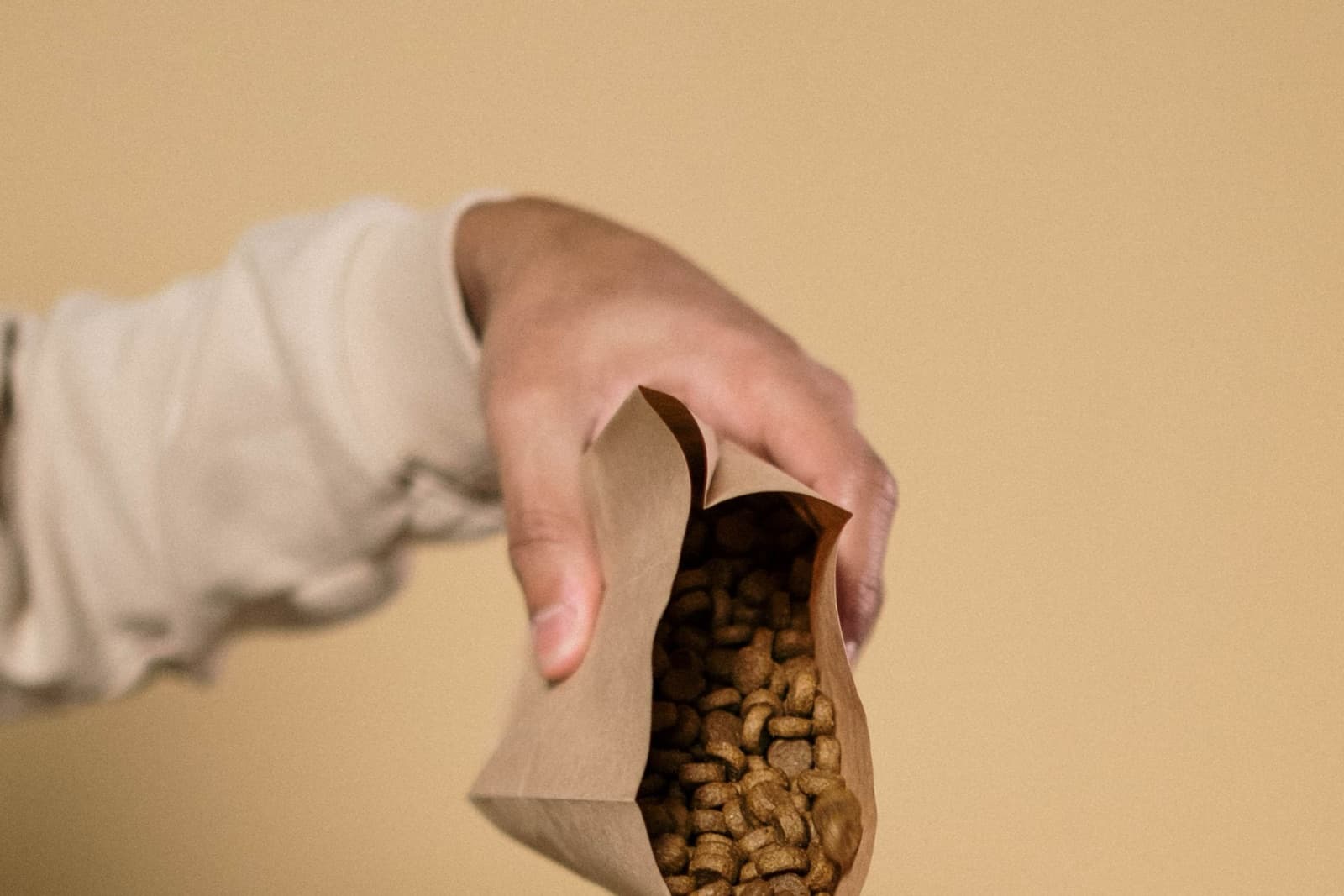
The editorial photograph illustrates dry pet food being served, not a tested storage container. Manufacturer and government links in this guide are ordinary reference links.